Decision quality is measured. Not assumed.
Every scoring model is backtested on historical data and validated on out-of-sample windows across multiple horizons and market regimes.
No fitted hindsight. No assumed accuracy. Only measured performance.
Built on a continuous, multi-domain data universe.
Exnet models operate on a unified data layer combining market, futures, portfolio, client, macro, ESG, and live news inputs. Each signal is evaluated in context — not in isolation.
Purpose-built models for financial decision systems.
Exnet does not rely on a single model or static methodology.
Different signals require different modelling approaches — depending on data structure, time horizon, and decision type.
The platform combines multiple model classes to generate robust, context-aware signals rather than isolated predictions.
Each model is selected, validated, and continuously evaluated based on decision outcomes — not theoretical fit.
No single model drives a decision. The system does.
Real-time model computation. Not batch analytics.
Exnet operates on a continuous compute layer — not periodic model runs.
Signals are generated, scored, and updated as underlying data changes across markets, portfolios, client behaviour, and macro conditions.
Models are not executed in isolation or on fixed schedules. They are recomputed dynamically as part of a live decision system.
- Continuous signal updates as conditions evolve
- Immediate re-ranking of decisions based on new information
- Consistent alignment between model outputs and current market state
Exnet integrates high-performance compute infrastructure, including GPU acceleration and distributed processing, to support real-time evaluation across thousands of signals simultaneously.
Decisions are computed — not refreshed.
Models produce decisions, not predictions.
Each model produces structured scores that map directly to a decision — not a dashboard. Every output is structured, ranked, and routed.
The scoring surface shows one signal resolved through the full decision path — from raw drivers to production workflow.
Signals are ranked. Decisions are proven.
Exnet converts continuous data into ranked signals — scored by probability, impact, and confidence.
Each signal is validated on forward data before deployment. Not backtested in hindsight — measured across time, regimes, and real decision windows.
- Signals ranked by probability, impact, confidence
- Tested across 30 / 60 / 100 day horizons
- Out-of-sample validation (no lookahead bias)
- Performance tracked per signal, not averages
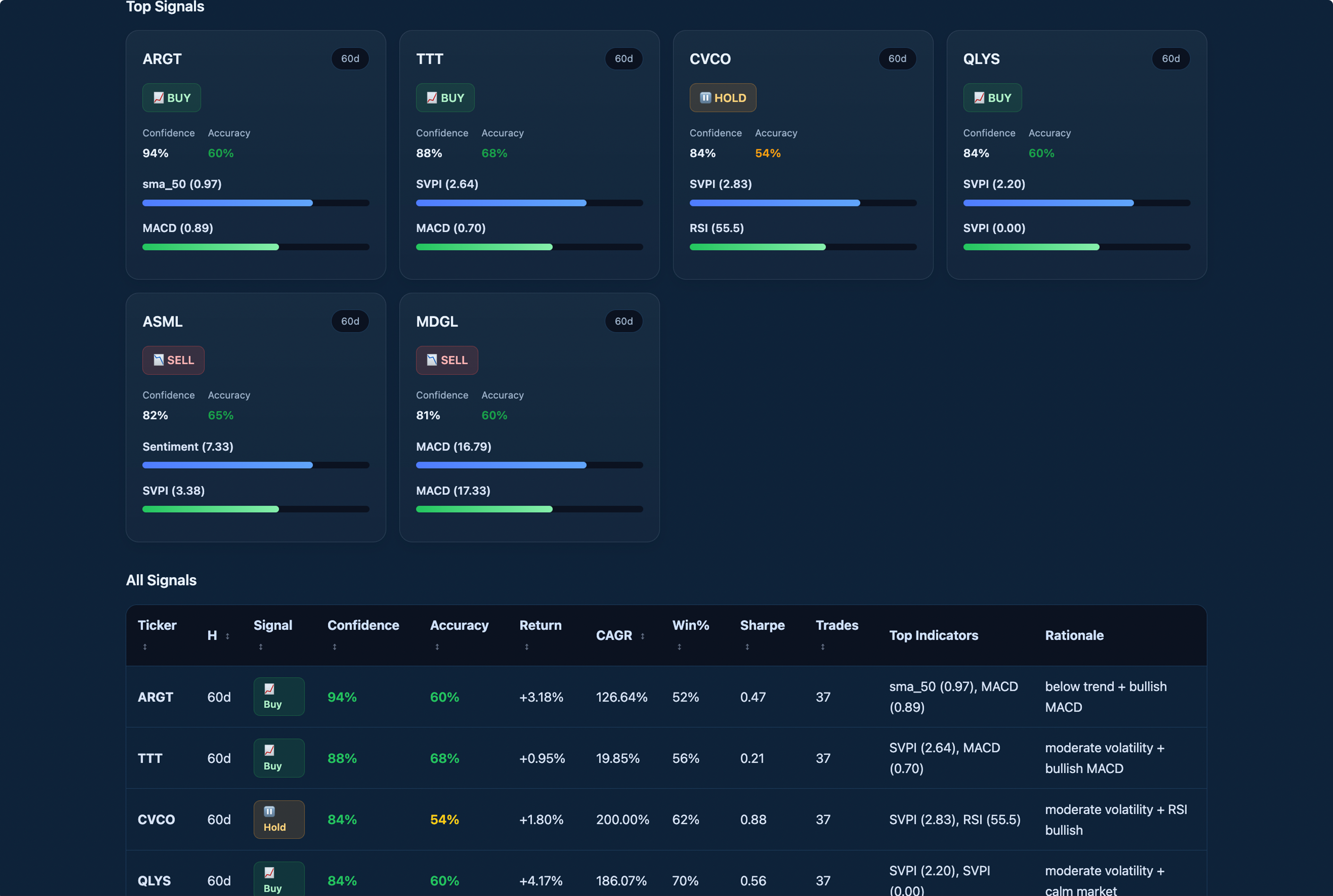
Performance is tracked at the signal level.
Exnet evaluates model performance based on decision outcomes, not statistical fit. Each signal is measured across time horizons, market regimes, and forward test windows.
- Accuracy (directional correctness)
- Win rate (successful outcomes)
- Confidence calibration
- Drawdown and downside risk
- Return impact and CAGR
Out-of-sample by design.
Every model is tested on forward data — not fitted to history. Performance is evaluated across time, across regimes, and across decision horizons before deployment.
- Rolling time splits (forward testing)
- Multi-horizon evaluation (30 / 60 / 100 days)
- Regime-aware validation (volatility, macro shifts)
- Per-signal performance tracking
Every signal is explainable.
Each recommendation is supported by its primary drivers across technical, macro, and behavioural signals.
From signal to decision. Fully measured.
Exnet connects model outputs directly to execution workflows. Signals are prioritised, validated, and routed — with full visibility into why a decision exists and how it performs over time.